A Teen's Lens
The Return to Panem: Deconstructing the Anticipation, Casting and Aesthetic Evolution of The Hunger Games: Sunrise on the Reaping

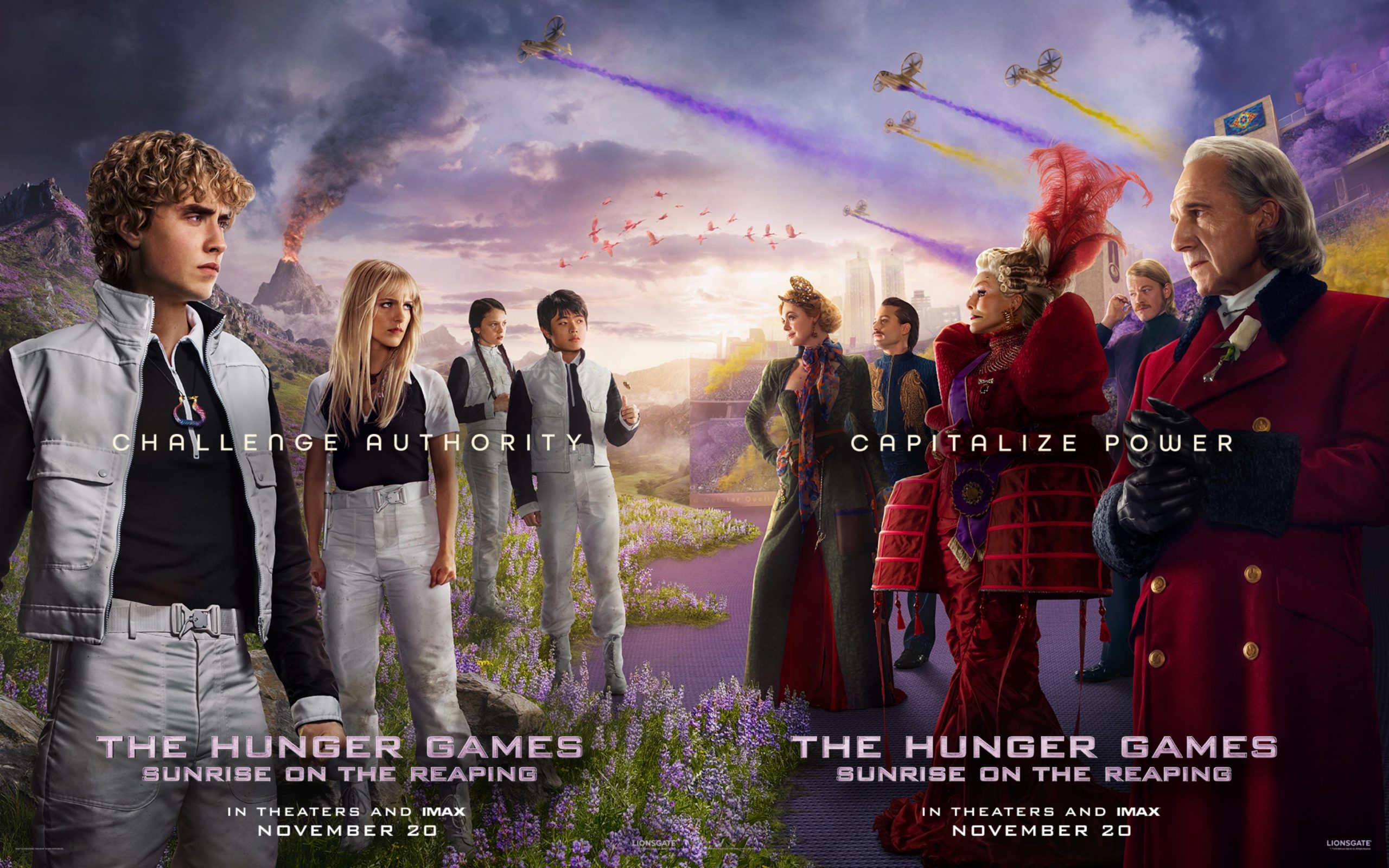
⚠️ SPOILER WARNING: This article contains spoilers from Suzanne Collins’ Sunrise on the Reaping.

The unveiling of the second official trailer for The Hunger Games: Sunrise on the Reaping has reignited global anticipation for Suzanne Collins’ dystopian universe. Set 24 years before Katniss Everdeen’s story and 40 years after The Ballad of Songbirds and Snakes, the film explores the notorious 50th Hunger Games, also known as the Second Quarter Quell.
By examining its narrative stakes, casting, fidelity to the source material and evolving visual language, Sunrise on the Reaping emerges as a particularly significant return to Panem, one that revisits a familiar world through the eyes of the character who helped audiences understand the Games in the first place.
Why Sunrise on the Reaping Exists: The Nuance of the 50th Quarter Quell
Unlike conventional prequels created simply to expand a franchise, Collins’ Hunger Games prequels have distinct thematic purposes. While The Ballad of Songbirds and Snakes examined the origins of authoritarianism and Coriolanus Snow’s relationship with power, Sunrise on the Reaping focuses heavily on propaganda, media manipulation and the control of information.
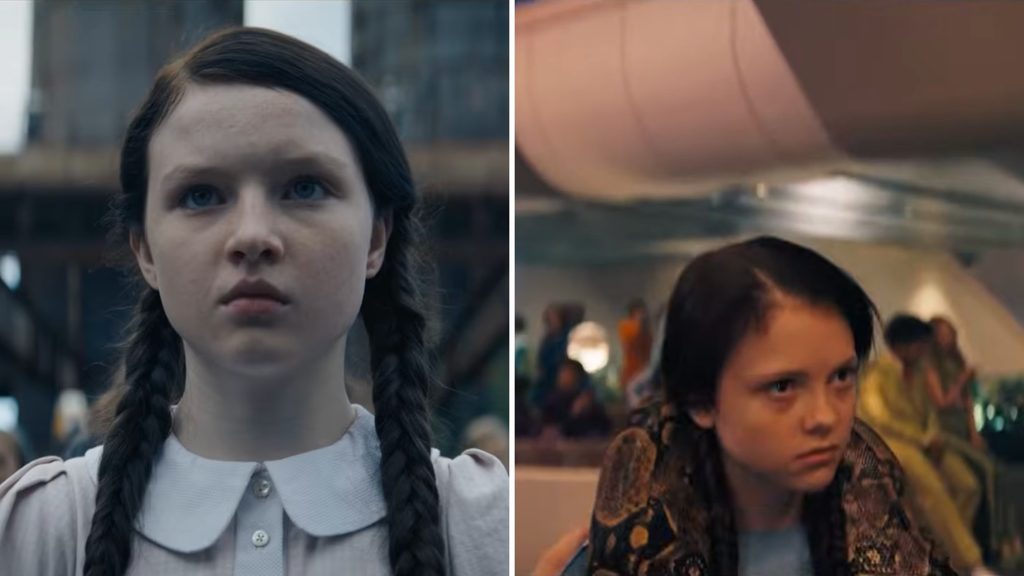
The novel demonstrates how the Capitol constructs its own version of reality, including the replacement of deceased tribute Louella McCoy with a drugged body double, Lou Lou, to preserve the illusion of order.
The Second Quarter Quell itself intensifies the Capitol’s cruelty. Instead of 24 tributes, 48 are selected, with four children taken from each district. The rule is presented as a deliberate reminder that for every Capitol citizen killed during the rebellion, two rebels died.
At its heart, however, the story is about humanising Haymitch Abernathy. For years, audiences have known him as Woody Harrelson’s cynical, alcoholic mentor. The novel strips away that image to reveal a 16-year-old boy who is intelligent, funny and hopeful, before the Games and their aftermath reshape him permanently.
Timeline of the Panem Saga:
[10th Hunger Games] (Ballad of Songbirds & Snakes) ── 40 Years ──> [50th Quarter Quell] (Sunrise on the Reaping) ── 24 Years ──> [74th Hunger Games] (Original Trilogy)

Casting and Characters:
Director Francis Lawrence and casting director Debra Zane faced the challenge of casting younger versions of characters audiences already associate with iconic performances. Leading the cast is Joseph Zada as Haymitch, portraying the character before years of trauma turn him into the hardened mentor audiences know. Mckenna Grace plays Maysilee Donner, whose connection to the mockingjay pin creates one of the story’s most important links to Katniss’ era, while Whitney Peak plays Lenore Dove Baird, Haymitch’s girlfriend and a key connection to the Covey legacy.

The supporting cast further bridges Panem’s past and future. Jesse Plemons plays a younger Plutarch Heavensbee, Elle Fanning portrays an earlier Effie Trinket, Kieran Culkin takes on Caesar Flickerman, and Maya Hawke and Kelvin Harrison Jr. play younger versions of Wiress and Beetee. Ralph Fiennes’ President Snow places another interpretation of the character within the franchise’s timeline.
Rather than simply imitating the original actors, the casting appears focused on capturing the characters before they became the people audiences remember. That distinction is especially important with Haymitch. Zada’s performance feels more open and optimistic than Harrelson’s, reflecting the person Haymitch was before the Games took that optimism away.
Visual Grammar
Over the course of the franchise, Panem has developed a distinct visual language. Sunrise on the Reaping appears to preserve that identity while introducing a palette suited to its own era.
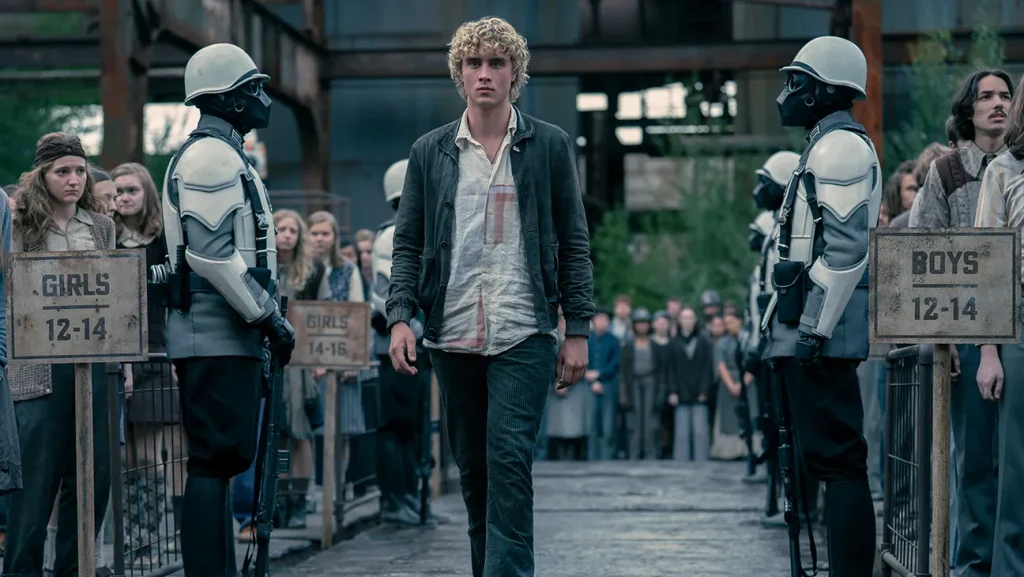
District 12 remains grounded in muted slate, earthy browns and overcast greys, reinforcing its poverty and oppression. The Capitol, meanwhile, retains its theatrical artificiality through brighter colours, retro styling and exaggerated production design.

The most striking departure comes in the arena. The Second Quarter Quell’s landscape is deliberately beautiful, filled with lush greenery, flowers, streams and bright skies. The trailers appear to embrace this with a more vibrant, saturated colour grade. The effect is deceptive by design: the brighter and more idyllic the arena looks, the more disturbing its violence becomes. The Capitol has effectively transformed nature into a colourful stage for death.
This distinguishes the film from the darker, more desaturated visual language of the later original films while remaining recognisably Panem.
How Faithful Is It to the Book?
From the trailers, Sunrise on the Reaping appears remarkably attentive to Collins’ novel. The arena closely reflects its description, including the distinctive eye-shaped Cornucopia, while the presence of 48 tributes establishes the scale of the Second Quarter Quell.
The trailers also preserve important character and symbolic details, particularly Haymitch’s relationship with Lenore Dove, the bird-and-snake striker and Maysilee’s connection to the mockingjay pin. Even smaller elements, including Glenn Close’s transformation into Drusilla Sickle, suggest that Collins’ descriptions have been taken seriously.
Some scenes have inevitably been rearranged or expanded for cinematic pacing, but the footage so far suggests an adaptation that is attempting to preserve not just the events of the novel, but its atmosphere and thematic intent.

There is, however, one notable limitation: the film’s PG-13 rating. Director Francis Lawrence has acknowledged that Collins’ novel “pulls no punches”, but certain moments cannot be depicted with the same graphic detail on screen. He specifically referenced the disturbing sequence involving a character holding a child’s severed head, explaining that it could not be shown explicitly within a PG-13 film.
That does not mean the film will necessarily be less violent. Lawrence has stressed that they still go “full on” with the story’s tragedy and trauma. Instead, the most graphic moments will likely rely on editing, sound, reactions and suggestion rather than explicit imagery. In this sense, the adaptation can remain faithful to the impact of Collins’ violence without reproducing every gruesome image literally.
A Familiar World, Seen Differently
What makes Sunrise on the Reaping particularly compelling is that its audience already knows how Haymitch’s story ends. We know he survives. We know he becomes Katniss’ mentor. We know what the Games eventually cost him. The suspense therefore lies less in whether Haymitch will live and more in watching the person he once was disappear.

The trailers suggest a film deeply conscious of that irony. Its bright arena, theatrical Capitol and youthful cast all exist against an audience’s knowledge of what comes next. The beauty becomes unsettling because we know what it is concealing, while Haymitch’s optimism becomes tragic because we know how difficult it will be for him to hold on to it.
Sunrise on the Reaping therefore feels less like a return to a familiar franchise and more like a return to the foundations of it. It takes the character who once stood behind Katniss and places him at the centre, revealing the boy behind the legend and the machinery behind the spectacle. If the final film carries through what its trailers have established, its greatest strength may lie not in recreating the Hunger Games audiences already know, but in showing why the Games left scars that lasted long after the cameras stopped rolling.