Art
Exploring the Art of Experimentation – Farrukh Shahab

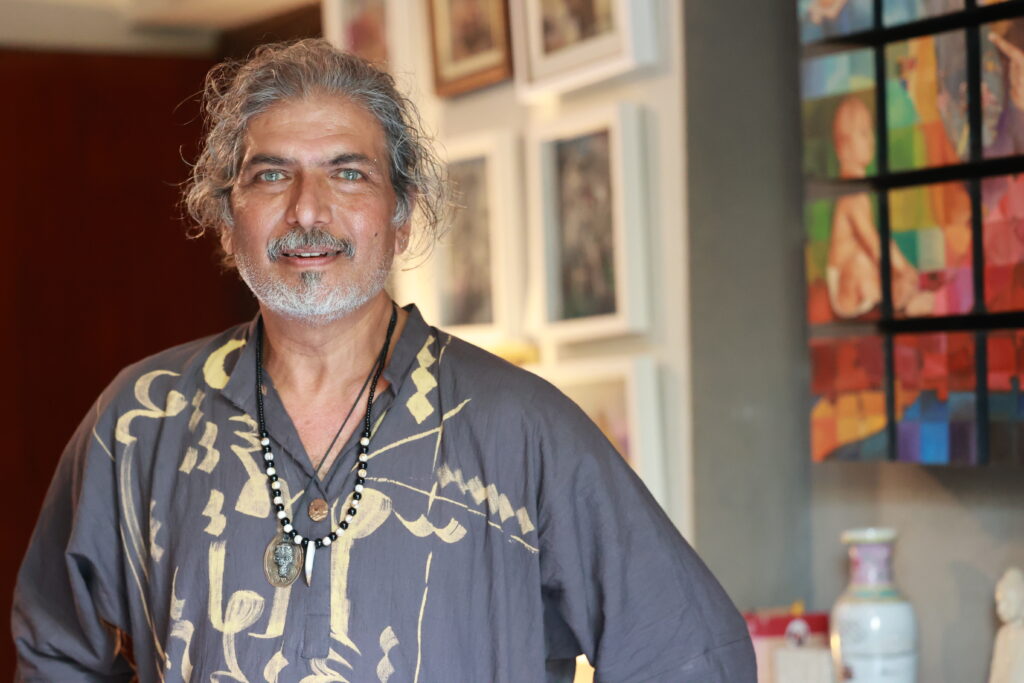
Growing up during a politically turbulent time had a profound influence on Farrukh Shahab. His family’s migration and resettlement exposed him early on to instability and change. He first lived in Rawalpindi and later moved to Karachi, during the late 1970s — a period marked by political unrest, student movements and social upheaval. Witnessing protests, the banning of student unions, and the tension that gripped the streets gave him a firsthand understanding of how politics shapes everyday life. Those experiences made him street-smart and observant, nurturing in a curiosity about the world and the human condition. In 1984, Shahab apprenticed under Iqbal Mehdi, a respected artist who was also surrounded by writers, poets, and political. Their discussions on art, literature, and ideology opened his mind to the power of creative expression as a form of reflection and resistance and helped him realize that art was not just about technique or aesthetics. His early works carried traces of that realism and social consciousness. The struggles, conversations, and observations from that era have continued to shape his worldview and remain deeply embedded in his artistic language today.
Your artistic journey began with portraiture, earning you awards as early as the 1990s. How do you view that early phase of your career in relation to your current work?
My early years were deeply rooted in portraiture, which became the foundation of my artistic journey. During university, a turning point came when my work was featured in the Sindh Art Exhibition in 1986, noticed by art critic Amjad Ali, who mentioned me in a leading newspaper, Dawn. That early recognition gave me the confidence to take art seriously and pursue it as a profession. Working as an apprentice to Iqbal Mehdi was a major influence. His studio was a training ground. We worked on commissioned portraits and large murals, sometimes twenty feet wide, for prominent figures and institutions. That experience taught me not only technique and discipline but also respect for craftsmanship and realism. I became very familiar with the medium; colour, form, texture and understood how to translate life onto canvas. Over time, however, I felt the need to move beyond replication. While realism gave me a strong foundation, I wanted to explore my own voice and direction. Breaking away from that comfort zone was essential to evolving as an artist. The early phase gave me precision and structure, but my current work draws more from emotion, memory, and experimentation – a dialogue between what I learned then and what I continue to discover now.
You’ve explored diverse styles — from figurative portraiture to abstraction, mixed media, and photography. How do you decide when to shift or experiment with a new style?
My shift toward experimentation began during my first trip abroad in 1992, when I accompanied Iqbal Mehdi for his exhibition at the Pakistan Mission to the United Nations in New York. That experience opened a new world for me. We also visited galleries across SoHo and other parts of the city, where I encountered a wide range of contemporary and abstract art. Coming from a background of strict realism, it was eye-opening to see how freely artists expressed ideas without the constraints of form or likeness. I even began taking small commissions there — portraits, mostly — but observing that diversity of styles planted a seed of curiosity. Gradually, I started exploring symbolic and nonrealistic forms in my own work. It wasn’t a sudden shift, but a natural evolution. Exposure to international art spaces — first in New York and later in Paris — expanded my perspective and made me realize that experimentation is essential for growth. It’s about responding to what I’m feeling at a certain point in time — sometimes it’s realism, sometimes abstraction, or even photography.
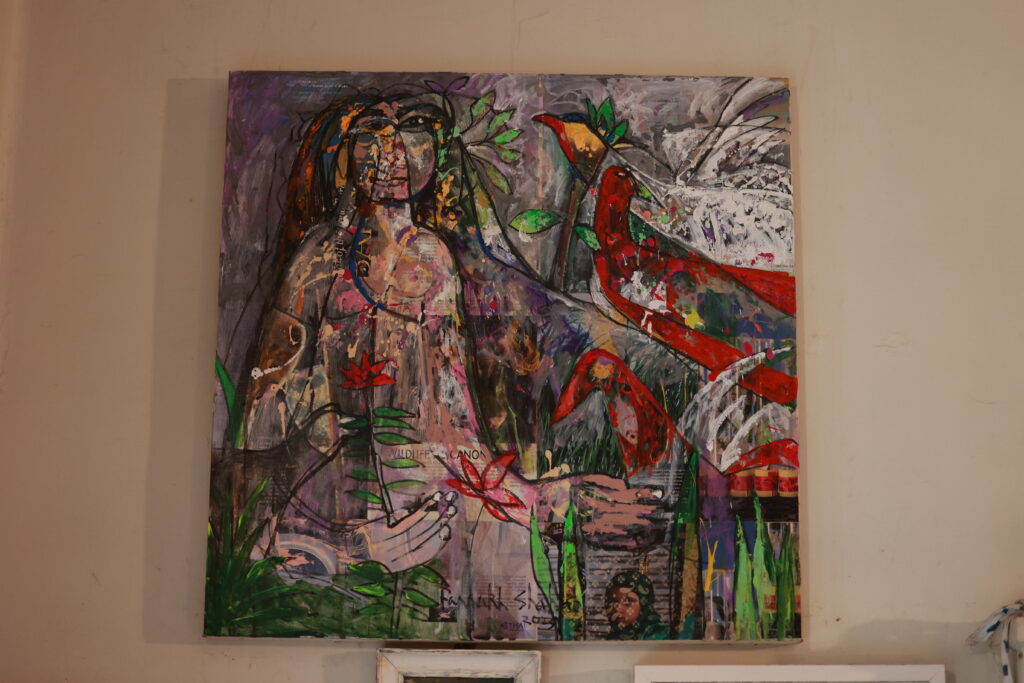
In Valley of the Quest, you integrate lapis dust, teakwood, and layered materials. What inspires your experimentation with unconventional mediums?
The idea of experimenting with unconventional materials began around the year 2000, shortly after I got married. My wife worked with an airline, and during our travels and stays abroad — particularly in London — I often found myself surrounded by everyday objects rather than traditional art supplies. I started using what was available: letters, cardboard, bits of paint, even discarded materials. That period became a quiet laboratory for exploration, though at the time I didn’t take it very seriously. Years later, while preparing for Valley of the Quest, my curator, Mohammad Ishaq, encouraged me to revisit that experimental approach. Once I began, it came naturally — the process flowed, and the material itself started to guide the form. I used lapis dust, teakwood, and layered surfaces to create depth and symbolism, drawing inspiration from The Conference of the Birds by Farid Uddin Attar. The text’s metaphors about the soul’s journey resonated deeply with me and became the conceptual backbone of the series. Each piece in Valley of the Quest reflects that spiritual search — birds as metaphors for human emotions, flight as transcendence, and materials as memory. The use of natural, tactile mediums connects the work to both earth and spirit.
How do you balance your personal need for artistic evolution with the art market’s expectation of a “signature style”?
I’ve never allowed the art market to dictate the direction of my work. When an artist starts creating with the market in mind, they risk becoming confined — producing what is expected rather than what is felt. That mindset slowly erodes individuality, originality and the natural evolution of creativity. What many forget is that the very work that first drew the market’s attention was born from pure, personal expression — not commercial calculation. Yet once an artist begins to sell, external influences can creep in. Galleries may suggest changes — colour adjustments, recurring themes, or familiar compositions — and before long, the artist is boxed into a “signature style” that serves the market more than their own vision. I’ve consciously resisted that. Growth, for me, lies in experimentation and change. Each phase of my work reflects a new internal journey, not a repetition of what has already been accepted.
You’ve spoken about the canvas as a space where art “takes on a life of its own.” Could you elaborate on what that loss of control means for you as an artist?
For me, painting is never a premeditated act. I don’t approach the canvas with a fixed plan or a detailed vision. The moment you try to control every aspect of a painting, it resists — it begins to transform into something else entirely. My process is intuitive: I start with a loose idea, then build, erase, add, and alter as the work unfolds. The composition, the colour palette, even the emotion evolve naturally as I paint. There are moments when the hand seems to move on its own, guided by something beyond conscious thought. That’s the point where the canvas takes on a life of its own. Sometimes the result isn’t what I imagined; sometimes it surpasses my expectations entirely. But that unpredictability is the essence of creation.
Many of your works embody both personal emotion and collective human experience. Do you consciously navigate between them?
I believe if you try to create art consciously with the intent of balancing the personal and the universal, it becomes more of an illustration than an expression. For me, the process is organic. Whatever you experience — whether from life, relationships, or even from what you see in galleries and around you — quietly settles in your subconscious. Those impressions stay there, sometimes for years, until they resurface in unexpected ways.
When I paint, it’s rarely a direct translation of an experience or emotion. The connection is deeper and often difficult to trace. It’s as if the body’s own chemistry and the mind’s stored memories come together on the canvas. Art, to me, is a mirror of the subconscious — it reflects fragments of who we are, often without our realizing it. Whether one is a painter, writer, or poet, the act of creation always carries something instinctive and internal, shaped by everything we’ve lived and everything we’ve forgotten.
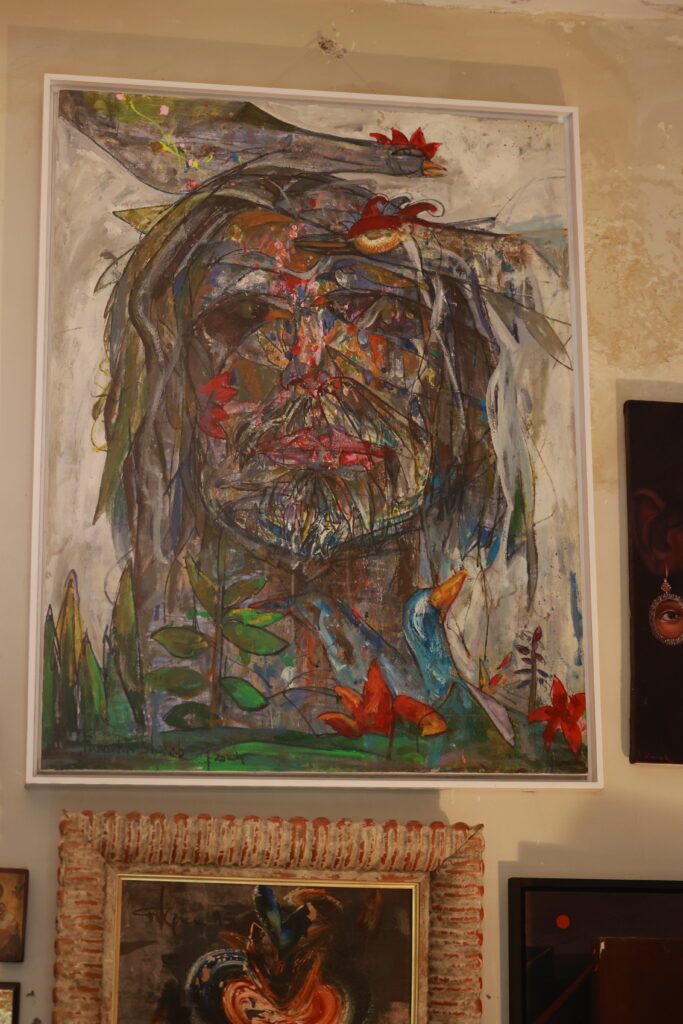
You’ve played an active role as Chairman of the Fine Arts Committee at the Arts Council of Pakistan. How do you view the responsibility of artists in shaping the country’s contemporary art scene?
It’s been about six years since I joined the Arts Council of Pakistan as a governing member, and the experience has been both unexpected and deeply rewarding. Initially, I never saw myself as a teacher or administrator — I’m a reserved person by nature — but over time, I discovered that guiding young artists can be just as fulfilling as creating art itself. My approach has never been to impose ideas or styles on students. Instead, I encourage them to find their own voice — to develop a personal language of expression. Reviewing their theses, discussing concepts, and watching them evolve into confident artists has been one of the most gratifying parts of this journey. Many of our alumni have gone on to build successful careers, which affirms the importance of giving emerging artists the space to explore and grow. Serving as Chairman of the Fine Arts Committee has also pushed me out of my comfort zone. Organizing exhibitions, workshops, and programs has shown me how collective effort shapes the art community.
What gaps do you think still exist in Pakistan’s art education and curatorial practices, and how are you contributing to bridging them?
Unfortunately, we’re witnessing a gradual decline in both the conventional gallery culture and the strength of art institutions in Pakistan. This has created a visible gap — not just in opportunities for young artists to exhibit their work, but also in the quality of curatorial engagement and mentorship available to them. Our focus has been to bridge that gap by creating more accessible platforms for emerging talent. We want young artists to feel encouraged rather than disheartened by the lack of formal infrastructure. Whether it’s through exhibitions, workshops, or performance-based art programmes, we’re trying to provide them with the space, visibility, and confidence to grow. People are often hesitant to embrace new ideas or formats, but this effort of involving students and fostering inclusivity is slowly gaining momentum. I see it as an ongoing mission: to keep the art ecosystem in Pakistan alive, evolving and open to the next generation of voices.
Winning the Nigaah Art Award for Abstract Art in 2024 affirmed your experimental work. How do such recognitions influence your artistic confidence or direction?
Recognition has always carried great value for me. I still remember the feeling of seeing my first painting printed in Dawn in 1986 — at that time, it felt monumental. Moments like those remind you that what you’re creating is being seen and appreciated, and that validation can be incredibly motivating. Winning the Nigaah Art Award for Abstract Art in 2024 was a similar moment of affirmation. It reinforced my belief in continuing to experiment and evolve. For any artist whether emerging or established, appreciation, acknowledgment, and even the simplest forms of recognition matter deeply. They renew your confidence, keep the creative spirit alive, and encourage you to push your boundaries further.
When future generations look back at your career, what do you hope they recognize as your defining contribution to Pakistani art?
People often say that an artist’s career is unpredictable, that it’s difficult to sustain oneself through art alone — but I’ve spent my entire life doing just that. It hasn’t always been easy, but it’s been deeply fulfilling. Once your work is out in the world, you have to be ready to face all kinds of responses — appreciation, criticism, or even indifference. That openness is part of being an artist. If future generations look back at my career, I hope they recognize it as one defined by persistence and courage — the courage to evolve, to take risks, and to experiment without fear of rejection.
You’ve seen the Pakistani art scene transform over three decades. What excites you most about the new generation of artists?
What excites me most is their openness — their willingness to experiment, to question, and to redefine what art can be. Over the years, I’ve witnessed remarkable growth in opportunities for young artists, compared to the past, from the rise of new galleries to the digital platforms that allow them to share their work instantly with the world. This generation is far more exposed and connected than we were. Their inspirations come from everywhere — from local traditions to global movements — and that diversity shows in their work. They are bold, unafraid to take risks, and eager to explore concepts that challenge conventions. It’s heartening to see Pakistani artists making their mark internationally, representing our culture and creativity with such confidence. Today, art and artists are no longer confined to one space or mindset.
If you could describe your art in three words — the words you’d want on a gallery wall decades from now — what would they be?
They would be dedication, evolution, and daring. Dedication — because art has been a lifelong commitment for me; Evolution — because I’ve never wanted to remain stagnant; every canvas is a step forward. And Daring — because experimentation and risk have always been at the heart of my creative process.