Bright Side
Redefining Motorsport in Pakistan – Dina Patel

At just twenty-two, Dina Patel has become one of the leading names in Pakistani motorsport. The youngest FIA-licensed female racer in the country, she competes through rallying, drifting, autocross, karting and sim racing. As the daughter of a rally legend, motorsport was always part of her world, but Dina has forged her own path with determination, discipline and a relentless drive to succeed. In this conversation, she reflects on her journey, the lessons racing has taught her, and her ambitions to represent Pakistan on the international stage.
Growing up around champions, what are some of your earliest memories of racetracks and rally cars and was there ever pressure to live up to the Patel name?
My earliest memories of motorsport are quite innocent. When I was very young, I would watch my father pack his bags and disappear for a week at a time. My mother would often travel with him, and as children all we knew was that our parents were away and we suddenly had a little more freedom at home. It was only later that I realised he was leaving to compete in rallies.
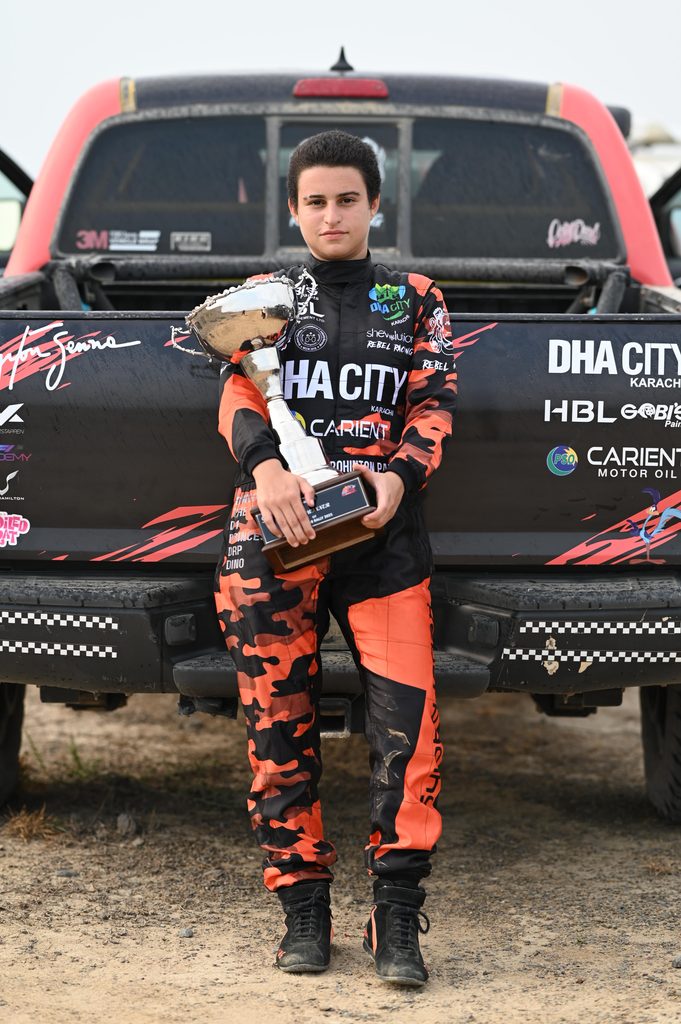
My first real rally experience was in Balochistan. The entire family travelled together into the desert, carrying enough supplies to survive anything. I remember insisting on being present at my father’s send-off before the race. Someone captured a photograph of that moment—me standing beside him wishing him luck. Years later, another photograph was taken in almost the exact same way, except this time he was sending me off to race. It was a powerful full-circle moment. As for pressure, I never saw it that way. In motorsport, if you allow pressure to control you, you are finished before you begin. Rather than pressure, I viewed my father’s achievements as a benchmark—an exceptionally high standard that inspired me to work harder and aim higher.
Your father famously tested your instincts by handing you a car in the desert and asked you to drive home.
I was around sixteen when that happened during the Jhal Magsi Rally. Looking back, Jhal feels almost like a second home because so many important memories were made there. My father handed me the keys to a modified Toyota Hilux and casually said that his foot was hurting and asked me to drive us back. At the time, I thought he genuinely needed help. What I didn’t realise was that he was quietly evaluating me.Driving a large off-road vehicle across desert terrain was completely different from anything I had experienced before. The vehicle was taller, heavier and far more demanding than anything I had driven. Yet I focused on one task: getting us home safely.Later, my father told me that the drive confirmed what he needed to know. He saw that I was comfortable under pressure and instinctively understood the terrain. Two years later, just six days after turning eighteen, I entered my first rally and became the youngest rally racer in Pakistan’s history to compete in the sport. Finishing on the podium in that debut event only reinforced what my father had already recognised in the desert—that motorsport was where I belonged.

How did you feel before your very first competitive race? Were you overwhelmed?
For four years I had been asking my father to teach me rallying. From the age of fourteen, I was constantly telling him that I wanted to race. However, he was unwavering in his principles. He refused to let me compete until I was eighteen and legally licensed to drive. His view was simple: if he expected others to respect the rules, his own daughter had to do the same.At the time, those four years felt endless. Looking back, they taught me patience and discipline. By the time I finally reached the starting line, I wasn’t overwhelmed by nerves. Instead, I was eager to prove that my belief in myself had been justified.That first rally represented far more than a race. It was the culmination of years of anticipation and preparation. More importantly, it was my opportunity to show my father that I could compete seriously in the sport he had dedicated much of his life to.
How would you describe your mindset when you’re sitting on the starting line?
My mindset today is very different from when I first started racing. Earlier in my career, I would become highly emotional and intensely energised before a race. Over time, however, I realised that the best drivers are often the calmest.Motorsport is a constant exercise in emotional control. At high speeds, every decision matters and every reaction has consequences. If you allow frustration, excitement or fear to take over, they begin making decisions for you. The goal is not to eliminate emotion but to manage it effectively.I often describe racing as controlled chaos. The car is moving at extraordinary speeds, the terrain is constantly changing, and there are countless variables beyond your control. Yet within that chaos, you must remain composed and focused. The difference between success and failure can be measured in fractions of a second.
Has there ever been a race where everything seemed to go wrong, but you still learned something invaluable from it?
Absolutely. In motorsport, some of the most important lessons come from the races you never finish. For me, that race was the Cholistan Desert Rally 2026.I had prepared relentlessly and was performing exceptionally well. Midway through the rally, I was on track to finish several minutes ahead of my competitors—a huge margin in a sport usually decided by seconds. Then, without warning, the car stopped. A fuel pump failure meant the engine was no longer receiving fuel, despite the tank being full.I was devastated. It was one of the biggest events of the season, I had recently signed a new sponsor, and I felt I had let everyone down. My father, who was co-driving with me, reacted very differently. While I was apologising, he simply laughed and told me, “From what I’ve seen today, you’re faster than I ever was. I don’t care that the car failed. I’m proud of you.”That moment completely changed my perspective. Cholistan taught me that results don’t always tell the full story. Sometimes the greatest victory is proving to yourself—and the people who matter—that you belong at the front.
Becoming Pakistan’s youngest FIA-licensed female racer and one of Pakistan’s highest-sponsored athletes, it’s a significant milestone. What did that achievement mean to you personally?
Becoming Pakistan’s youngest FIA-licensed female racer happened almost by accident. I entered a karting competition simply because I love racing and wanted to challenge myself. After winning, I discovered that the event qualified me for an FIA licence, opening the door to international opportunities in motorsport.For me, the licence represented more than a title. It was proof that I could compete beyond Pakistan and pursue my goal of representing the country on the international stage.Being one of Pakistan’s most highly sponsored athletes is equally meaningful. Sponsorship is a vote of confidence. Companies invest because they believe in your talent, potential and professionalism. When organisations such as DHA and HBL AMC choose to support me, it reinforces that the work I’m putting in is being recognised.

Looking back at your victories in events such as the Thar Desert Rally, Hub Rally, Cross, Cholistan Desert Rally, and Jal Magsi Challenge, which win holds the most emotional value for you and why?
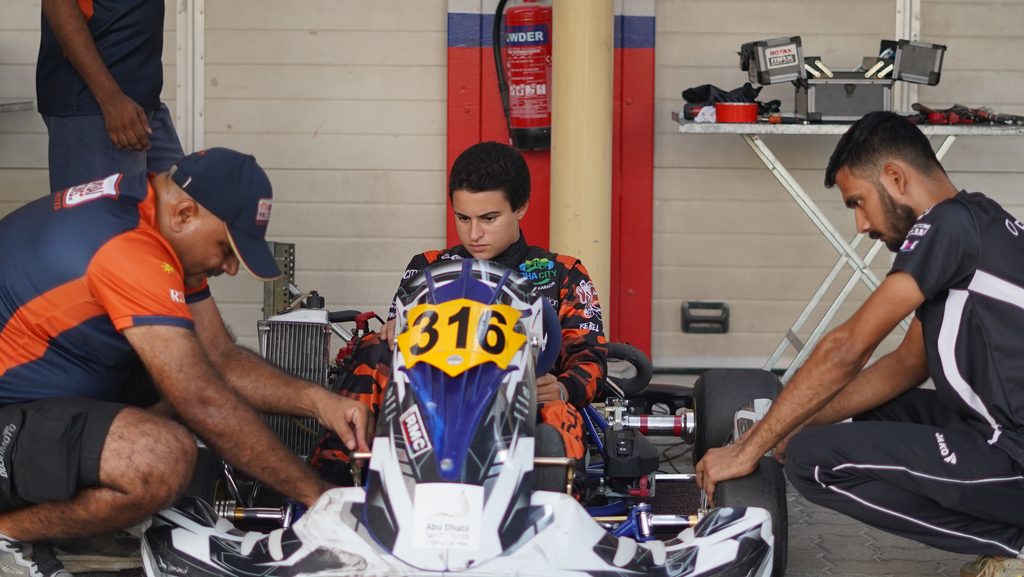
Surprisingly, it wasn’t any of those victories. The moment that means the most to me was transitioning from rallying to karting.Most racers start in karting and move into other disciplines. I did the opposite, which meant unlearning many of the habits I had developed in rallying and rebuilding my driving style from scratch. It was one of the most challenging periods of my career.The breakthrough came when I broke Pakistan’s national female karting record and posted a top-eight national karting time overall. Reducing my lap time by nearly four seconds was a huge achievement and proved to me that I could adapt and succeed in an entirely different discipline.What made it especially meaningful was that karting is incredibly individual. There’s no co-driver and no one beside you—just you, the machine and your decisions. That experience taught me resilience, self-belief and the importance of trusting my instincts. More than any trophy, that personal growth is what I’m most proud of.
You’ve been a panelist at Shevolution 2.0. So, how does it feel to be recognized as Pakistan’s first female drifter making history in an entirely new discipline while also representing women in a mainly male-dominated field?
Being part of Shevolution 2.0 was a privilege because it brought together women who are breaking barriers in their respective fields. It reinforced how important representation is and how much impact visibility can have.The most rewarding part of my journey is inspiring younger girls. Whenever someone tells me they want to pursue motorsport because they’ve seen my work, it reminds me that success is more than winning races—it’s about opening doors for others.Becoming Pakistan’s first female drifter was important because I wanted that milestone to come from a professional racing background. Motorsport requires discipline, skill and training, and I wanted to help change perceptions around the sport.
Have you encountered moments where you felt you had to prove yourself more, because you were a woman?
Interestingly, that hasn’t really been my experience. If anything, people tend to take me very seriously because of the environment I come from, the training I’ve received and the way I approach the sport.I have a very competitive personality when I’m racing, and I think that comes across. Once people see me on the track, gender quickly becomes irrelevant because performance speaks for itself. Motorsport has always been one of those fields where results are difficult to argue with.Of course, there are moments when people see my age and assume I’m inexperienced, but that usually changes once they see me drive. Ultimately, I’ve found that confidence, preparation and consistency earn respect far more effectively than trying to prove a point.
You once said that on the track, performance is what matters, not gender, and you also are the first ever ambassador of FERN, do you think the motorsport culture in Pakistan is evolving in that direction?
I do believe motorsport in Pakistan is moving in the right direction. One example is my role as the first ambassador for FERN, a student-led engineering initiative where young people design and build Formula-style race cars from scratch.What impressed me most was seeing students as young as sixteen and university graduates working together to create something genuinely innovative. When I had the opportunity to test one of their cars, I was amazed by the level of engineering and dedication involved.Projects like FIRN show that motorsport is becoming more than just racing—it is encouraging interest in engineering, technology and STEM education. Universities are beginning to take motorsport more seriously, and young people are seeing it as a legitimate career path rather than simply a hobby.That progress is exciting because a strong motorsport culture depends not only on drivers, but also on engineers, designers and innovators. Seeing that ecosystem develop in Pakistan gives me a lot of optimism for the future.

You’ve trained internationally and worked with experienced racers, what is the most valuable lesson you’ve learned from competing and training abroad?
The biggest lesson I learned abroad is that nobody cares who you are or where you come from—only how you perform.In international motorsport, reputation, family connections and social media presence mean very little once you put on a helmet. The only thing that matters is whether you can deliver on the track. I actually find that incredibly refreshing because it creates a true meritocracy.Training abroad also exposed me to a much higher level of competition. It forced me to look beyond local benchmarks and measure myself against drivers from around the world. That experience taught me humility, discipline and the importance of continuous improvement.
Fear is a natural part of high-speed racing; how do you manage it when you earlier said that you need to have a calm mindset when you’re in the car?
I don’t think fear is something that should be ignored. More often than not, fear is information. It is your mind and body telling you to pay attention to something.The key is understanding the source of that fear. If it is pointing towards a genuine issue—whether that’s fatigue, dehydration, poor preparation or a mechanical concern—then it should be addressed. Ignoring those signals would be irresponsible.However, if the fear is based purely on hypothetical scenarios, such as worrying about what might happen or whether you might fail, then it becomes a distraction. In those situations, the challenge is learning to control your thoughts and stay focused on the task at hand.
What does a typical training week look like for you when you’re preparing for a race season, and how do you prepare physically and mentally before a major competition?
Preparing for a race requires as much mental discipline as physical fitness. Physically, my training focuses on strength, endurance and stamina. I do a lot of calisthenics, including bodyweight exercises such as pull-ups and push-ups, alongside endurance swimming to prepare for the demands of long races.Nutrition is equally important. During training periods, I increase my protein intake and pay close attention to recovery and overall performance.Mentally, I spend a great deal of time reading, meditating and visualising race scenarios. I know some people dismiss these practices, but I believe they play a major role in high-performance sport. Motorsport is as much a mental challenge as a physical one.