Cover story
An Enigmatic Presence – Emmad Irfani

In an industry increasingly addicted to overexposure, incessant digital commentary and instant accessibility, Emmad Irfani has built an empire on the lost art of distance. Where the modern star is often expected to broadcast every fleeting thought, behind-the-scenes mundane detail, and personal milestone to maintain relevance, Emmad operates in a distinctly different register. He represents a rare breed of performer: one who understands that an actor’s greatest tool is not his omnipresence, but his visual and emotional economy. Often celebrated for his quiet intensity, refined physicality, and effortless screen aura, Emmad is less a celebrity chasing transient visibility and more a patient craftsman surrendered to the work.
“I belong to the school of thought where less was always more,” Emmad reflects with characteristic composure. “Mystery is necessary… if everything is predictable, there is absolutely no charm left.” In that single philosophy lies his quiet, deliberate defiance, not just against the frantic demands of modern stardom, but against the broader noise of a world that demands everything be packaged, uploaded and put on immediate display.


Born into a family with a strong military background, Emmad Irfani’s initial trajectory was defined by the discipline of sports and the structured routines of academic life. Athletics taught him the fundamentals of perseverance, spatial awareness and resilience—traits that would later become the bedrock of his performance methodology. When he eventually transitioned into the world of high fashion, his striking presence and classic features quickly made him one of the most sought-after male models in the region. Yet, where others might have settled into the comfortable validation of fashion runways and high-end campaigns, Emmad recognized modeling as merely a precursor—a trial run in mastering body language before stepping into narrative storytelling.
The transition from the runway to complex television drama was neither instant nor without its specific trials. The screen required a complete unlearning of the model’s static perfection; it demanded vulnerability, psychological messiness, and a willingness to be unlovely. Over years of steady, deliberate work, Emmad eroded the pristine exterior to reveal an actor capable of remarkable internal dissonance.
Following the massive cultural footprint of Kabhi Mein Kabhi Tum—a show that dramatically expanded his visibility and reach—and the grounded, emotionally taxing weight of Kafeel, Emmad finds himself standing at a pivotal career horizon. Yet, true to form, he resists the romantic mythology of a singular “defining moment” or the intoxicating high of a commercial peak. Instead, he anchors himself firmly in the unglamorous mechanics of daily effort and mental balance. “Life is all about being on track. You get off track, you get back on track,” Emmad muses calmly. “End of the day, results are not in your hands… what you can do is have control over your emotions, your effort, your attitude and when the opportunity comes, you give it your all, your 100 percent.” There is no frantic chasing of validation in his demeanor, no anxious posturing to capture the news cycle, only a deeply grounded commitment to the process itself.
In a landscape where young actors are routinely advised to take every project offered to remain in the public consciousness, Emmad’s trajectory stands as a study in radical selectivity. He has spent years building a portfolio without ever appearing particularly interested in being everywhere at once. This approach is not born of arrogance, but of a clear-eyed understanding of his own artistic parameters and a refusal to dilute his energy across trivial work.

“Success… I don’t go after it now. I’ve become relaxed,” Emmad confesses with striking candor. “If you pin your expectations to something, disappointment comes. You feel disappointed when things don’t go according to plan. So, I’ve become a little disassociated with the result, or success, or failure. One day at a time. It’s just about being in the present now.”
This philosophical detachment from outcomes has sharpened his process of project selection. For Emmad, agreeing to lend his face, voice and spirit to a script requires a meticulous checklist—a holistic calculation where the narrative ecosystem matters far more than mere screen time or grand heroic gestures.
“Everyone has their own approach. If you want to term it this way, you can say that I like to be selective because there are a lot of boxes that I must tick before I go on a project,” Emmad explains. “It’s a combination of a lot of things. The production house, the script, the team, the co-stars, the director, the screen time, the character… Is he inspiring me? Is it a challenging character? There are a lot of factors that go into the thought process of me eventually giving life to that character.” He carries this intent into every single frame, allowing the craft to speak cleanly while keeping the man behind it carefully guarded from external erosion.
Long before the current wave of industry acclaim, there was an internal evolution, a process of learning how to navigate the complex surrender that acting demands. An actor, in Emmad’s view, is not a self-contained island of ego, but an instrument meant to interpret a larger, unifying vision. “At the end of the day, you’re the medium of a director. That character is the director’s vision in their head,” he notes. “She or he is an invisible force that’s going to tell that story.”
Working under the directorship of Mehreen Jabbar in Gulbahar offered a uniquely disciplined calibration—a physical and behavioral restructuring that challenged his established physical habits. Jabbar’s renowned naturalistic approach required him to strip away any residual theatricality, forcing a deep alignment with the director’s specific, understated rhythm. “Mehreen needs absolutely no introduction. Whenever I go on a project, my first attempt is to surrender to what the director’s vision is,” Emmad shares. “She wanted a little different body language for the character of Shehryar. It wasn’t a surprise, but it was a challenge. It was a challenge to be on the director’s strings, telling you, ‘Don’t sit like that, don’t use your hands, don’t scrunch your eyes, don’t put tension on your face.‘ This was happening for the first time.”
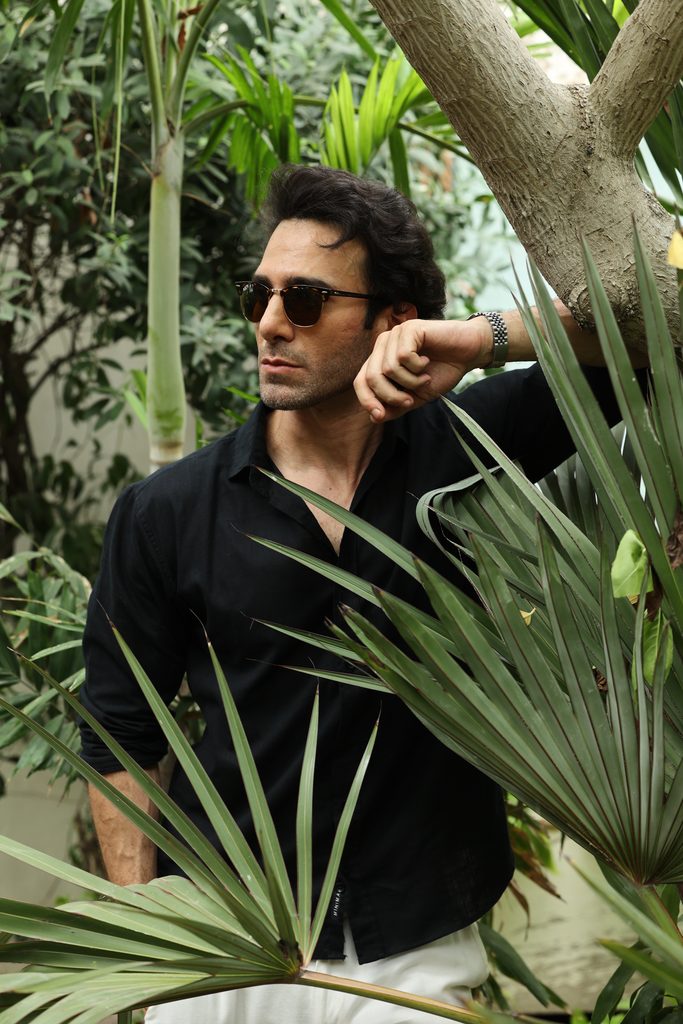

For an actor whose previous roles often permitted a broader physical expressive scope, that micro-direction became an exercise in extreme internal focus. It proved that true presence often lies in total physical stillness. Yet, when handed creative autonomy by directors with different sensibilities, Emmad experiences a rare, liberating alignment. The tension between strict directorial control and actorly interpretation is where he finds the true dynamic range of his profession. “Certain directors give you that freedom… and you kind of feel invincible, like you can do nothing wrong,” he reveals with a slight smile. “It’s always good to work with directors who give you that freedom. They give you a canvas, and you paint the canvas. At times, there was freedom. At times, I had to play the notes according to what the ringleader or the orchestra leader wanted me to play.”
This fluid movement between submission and ownership has allowed Emmad to navigate vastly contrasting narrative dynamics, perhaps most fascinatingly illustrated in his recurring screen partnerships. Reuniting with a co-star across fundamentally different stories demands an unlearning of previous muscle memory—a task Emmad approaches with cerebral rigour. Re-encountering Sanam Saeed on set for Gulbahar after their complex dynamic in Kafeel offered a stark narrative departure. Where their previous project was defined by friction, hostility and fractured intimacy, Gulbahar called for a complete inversion of emotional tone. “The previous role with Sanam was very disrespectful. And this is the opposite, it will be a very sharp, very big contrast,” Emmad reveals. “First, I would not be rude to her. Just very nice to her! With Sanam, it seems that we have this mutual respect, this mutual camaraderie. It’s very easy to work with her. She’s very professional, and she’s obviously an icon in acting. What she does is, she does her thing and I do mine. And somehow, we create something.”
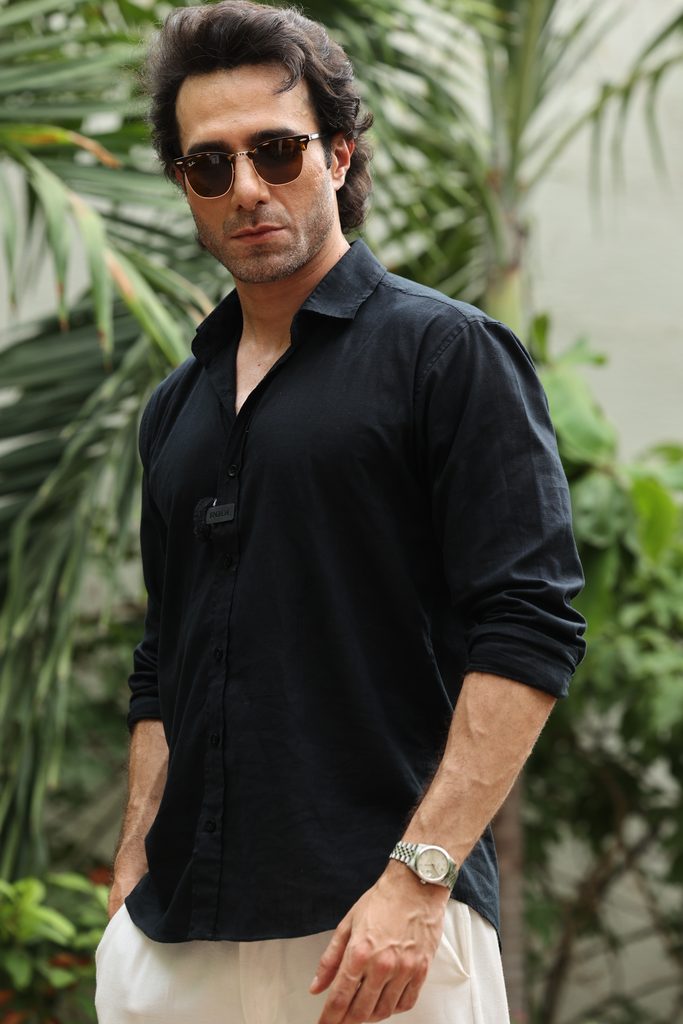
That creative spark hinges on his firm conviction that acting is rarely about explicit conflict, but rather about the subtle, unspoken currents running beneath a scene. “Acting is a lot about breaking barriers, and whatever the given circumstances or the character demands at that point, you deliver,” Emmad notes thoughtfully. “I always believe acting is a lot about what is not being said. Because in life also, we say something else, but our subtext or subliminal intention wants to describe something else. All these characters are in fiction, but they are inspired by reality. So, for sure, there will be a lot of conflicts, a lot of ups and downs… and yes, a lot that’s going beneath the surface.”
If characters like Adeel and Jami established his gift for portraying men carrying complex internal shadow-lives, Emmad’s approach to anti-heroes, compromised figures and deeply flawed protagonists remains strictly non-judgmental. He refuses the comfort of easy moral categorization, approaching every character as a messy, real human being whose actions stem from specific, identifiable wounds. “As an actor, you portray all sorts of people in the world. So, once you are given a character, I think there is absolutely no room to judge that character,” Emmad asserts firmly. “They are human. They have fears, insecurities, traumas and unprocessed emotions. Portraying these characters is a privilege—you get to live so many lives, you get to portray people that you have not met in real life.”
His preparation process begins not with memorizing lines or planning superficial gestures, but with an internal audit of identity—measuring the precise distance between the character’s psyche and his own. “Whenever I take on a character, the first thing I ask myself is: how much does this character resemble me, and how much is he different from me? The aspects that are like me are not as challenging, but the differences are where I really must put in the work. That, for me, is the real challenge.”
This deliberate search for contrast has required a deeper, more personal reconciliation with his own internal standards over the years. In discussing his earlier career, Emmad speaks with remarkable honesty about the severe demands he once placed upon himself. “I have not been comfortable in my skin for a very long time,” Emmad admits. “But with time, age, wisdom and experience, I think I am better in my skin—if not completely comfortable, then certainly better. I am not hard on myself anymore. I am relaxed with things; I take one day at a time, one ball at a time.” Self-compassion, mental conditioning, and quiet reflection have gradually replaced the rigid, stressful perfectionism of his youth.


“Self-compassion and a lot of self-therapy, self-improvement, development… it’s all about your emotions, how you are feeling, how you perceive the world, your perspective,” he continues. “Coming back to the point of being hard on myself: yes, I try to prep a lot, invest myself in the script, and stay focused because end of the day, you are creating an artificial reality and there is no single right or wrong way. Acting is such a beautiful profession because every actor in the world will have a completely different approach to how they go about their work.”
Emmad’s relationship with the public eye remains governed by a protective boundary. In an era where celebrities are routinely nudged to transform their private lives, personal relationships and off-camera moments into monetizeable content, his refusal to comply feels almost revolutionary. “You see, I belong to the school of thought and the era where actors and stars used to have a mystery. You used to have very little access to their interviews or to see them,” he explains. “Overall, there should be an enigma. People think they know you because they’ve seen you laughing, being angry, or being romantic in the stories that they watch on screen. But I am generally a very private person., but my profession is in the public eye. That’s the dichotomy of my existence.”
Rather than viewing career lulls, slower phases, or industry unpredictability as setbacks, Emmad views every shift in momentum through the lens of continuous personal evolution. Having experienced both periods of overwhelming activity and quiet stretches where work seemed to stall, he approaches the ebb and flow of the entertainment business with stoic clarity. “In life, you will be beaten, you will have rocky roads, you will have smooth highways, you will have your ups and downs,” Emmad reflects. “Sometimes, you can be shattered by setbacks, or you can be motivated by them. I take everything as a stride in my step. I try to ensure that from any experience, good or bad, there is some learning. The learning never stops. That’s life.”
What drives him forward now is no longer the lure of fame, the applause of the crowd or the accumulation of career milestones, but the unending, quiet work of inner development. “Personal development, personal growth, the idea of developing myself to the point where I can totally and truly rely on myself,” Emmad concludes. “Because acting is ultimately all about developing yourself—your voice, your body language, your thinking, your social skills, your confidence. Self-improvement… that’s what gets me out of bed every morning.”
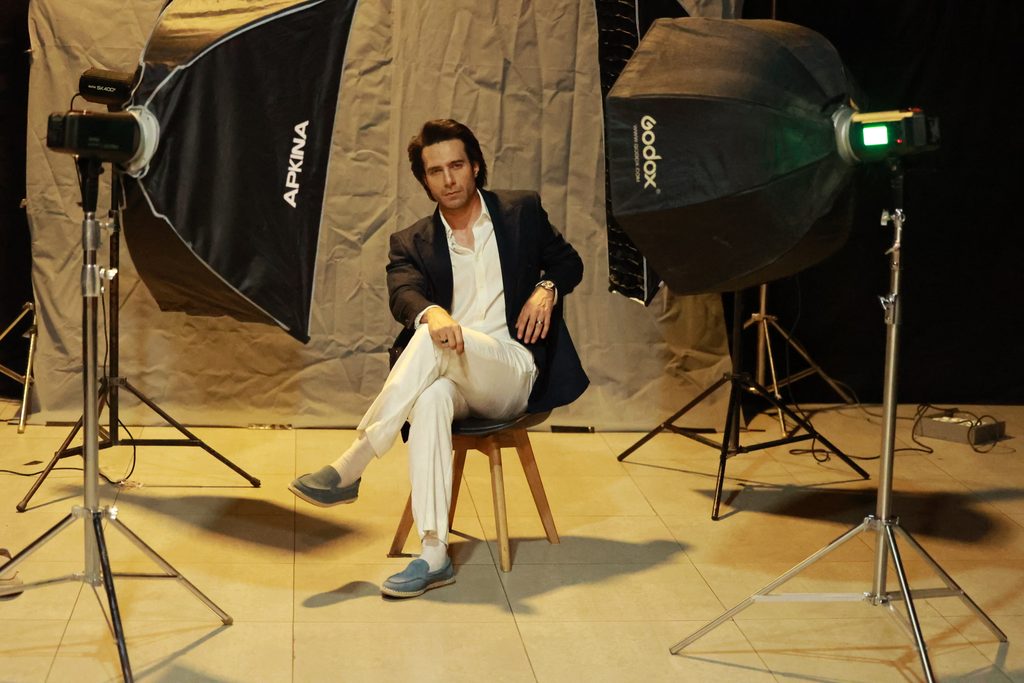

There are rare and definitive moments in an actor’s journey when presence is defined by the quiet authority, they project simply by standing still. Emmad Irfani is currently living that moment. Unmoved by the overwhelming frenzy of contemporary celebrity, he remains grounded, remarkably precise, and entirely at peace with his own pace. He shows up, does the arduous work, surrenders to the narrative and then, he steps quietly back into his life. “I’ve become a little disassociated with the result… I’m just in the present now.”
From the high-octane runways to the complex, emotionally shadowed television narratives of today, Emmad Irfani is not merely a dependable star—he is a compelling study in composure. From noise to nuance, from frantic ambition to quiet alignment, from superficial performance to undeniable presence, he gives you everything required on screen and keeps just enough of himself guarded in the shadows to preserve the magic.